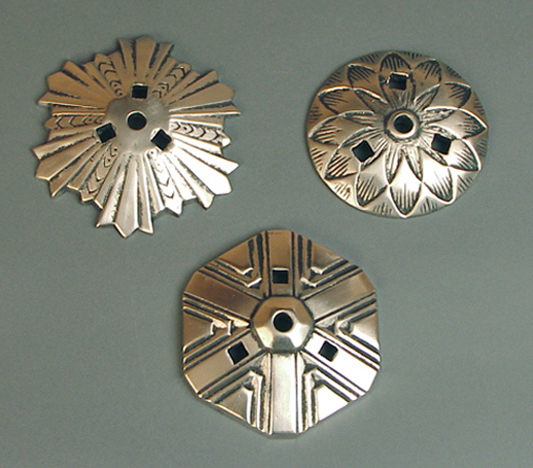
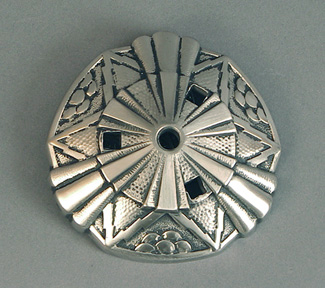
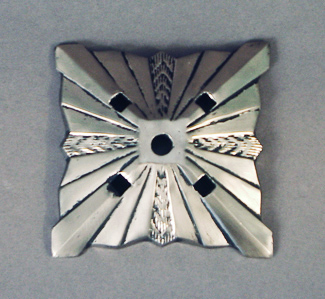
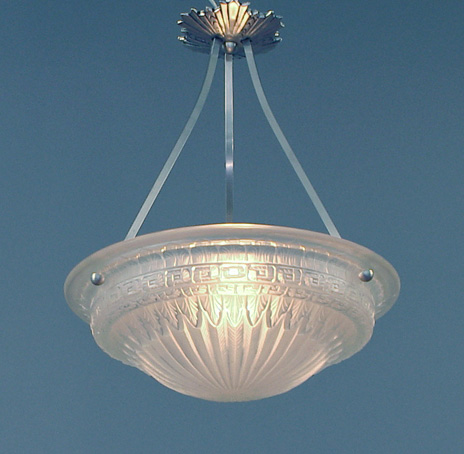
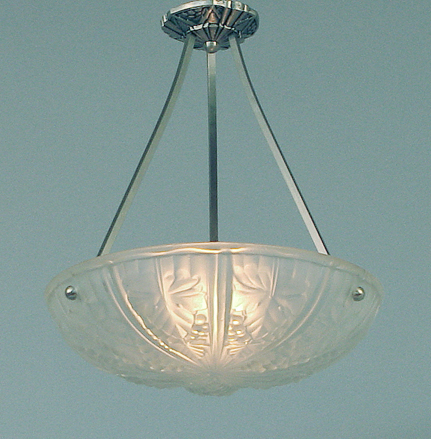
Where but DECORUM can you choose from a truly fantastic group of French antique lighting bowls, match them with the canopy of your choice, and have them custom-configured to your length requirements? These "pressed glass" bowls, as French dealers call them (most of which were made in the 1920s), are excellent lighting choices for situations where substantial light is needed and ceiling height is limited. I usually position just one standard-base socket right in the center of the bowl to light it evenly (three sockets can also be fitted if necessary). You can use a 150-watt, even a 250-watt bulb in it if you like (and if the Global Warming Cops don't arrest you)! Put the fixture on a wall dimmer and get mood when you want -- the incandescent bulb at a lower wattage will deliver a warmer light, often giving a golden glow to the bowl. Crank it all the way up and bring out the Scrabble board! Generally these bowls measure about 14 inches in diameter. The depth of the bowl by itself varies between two and seven inches. In these photos I've rigged the bowls with pretty short hardware; most hang between 14 and 18 inches from the ceiling (I can make them slightly shorter, the shortest being about 10 inches from ceiling to the bottom of the bowl). That means they qualify for your short, eight-foot ceiling, leaving you with only slightly less than seven feet of head room, clearance for most of your non-basketball-champ friends. Length beyond 18 inches? No problem! Choose your metal finish! I like brushed nickel best by far (my recommended finish)? Chrome suits you? Polished (bright) nickel? No problem (just time and money). The components are all solid brass or bronze to begin with so you'll be getting a top-quality plating job, and there will never be any deterioration due to rusting or corrosion of the metal. I use brass tubing which is 1/4" square, and it can be cut to whatever length suits your purposes. I've reproduced four impossible-to-get vintage canopies (all compelling, original French Art Deco designs) in solid bronze. Here they are in all their glory, freshly plated in brushed nickel and patinated. (And, for your consideration about whether they will cover the electrical box you have, the specs: Top left, the "star," will cover 3 7/8" ceiling opening; the round one to the right will cover an opening of 4 1/16"; the hexagonal one will cover an opening of 4 1/4"; and the one shown by itself below those three will cover an opening of 4". The four-hole canopy, the last one, will cover an opening of 3 7/8". You can easily fill in any gaps around the periphery with spackle or caulk or "mud." These canopies are available for sale by themselves or with the rest of their hanging works, fashioned to your custom length.
And... in an amazing flash of glory, my newest creation (below), a four-hole canopy for that rare four-hole bowl, which includes many Lalique bowls. At last you can use that Lalique treasure that's been in the closet all these years, because you've had no way to hang it! Like the others above, it's made of cast bronze, with a brushed nickel finish (other finishes available), and it's about four inches across. I'll create the rest of the hanging works to your exact specifications!
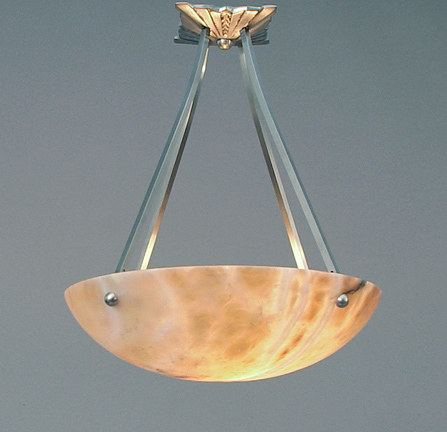
Here's an example of this last canopy splendidly doing its job:
This alabaster beauty hangs about 16 1/2 long. Also, now hanging magnificently in Maureen's entryway! SOLD!! ***** ONWARD with frosted bowls currently for sale. Keep in mind as you're looking at these bowls that most of them are made of colorless, frosted glass. Unhappily, photographing them with incandescent bulbs yields results that suggest warm colors in the yellow-pink ranges. NOT TRUE in reality!!
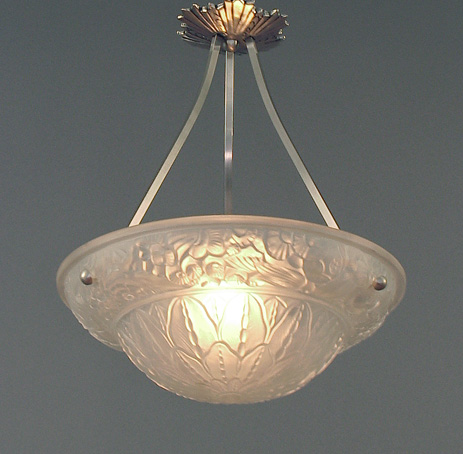
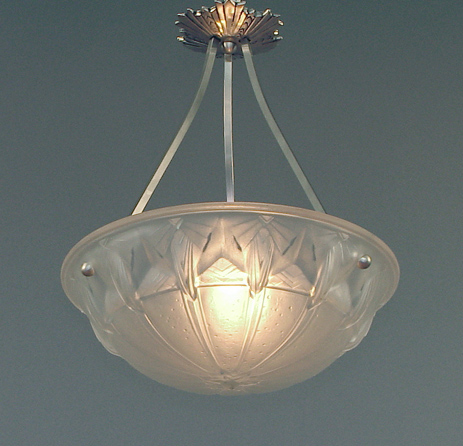
(A) This opulent bowl has that "cornucopia of nature" look so popular with the French. And why wouldn't it, having been designed by one of their very top design guns, the inimitable Pierre d'Avesn (unsigned, but widely attributed to the master)! Configured with curved brushed nickel tubes (as seen above) and the canopy of your choice (also as seen above), to your custom length specifications. Note: the glass is colorless, frosted. (e-mail Jack to start the conversation)
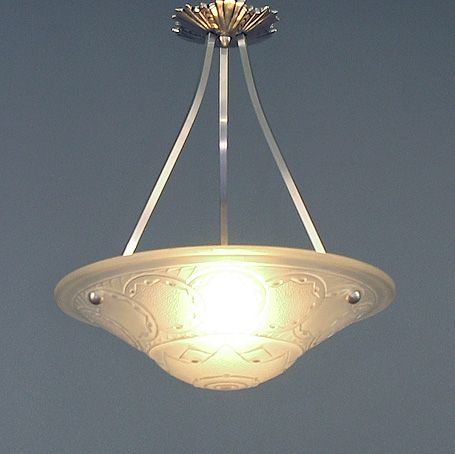
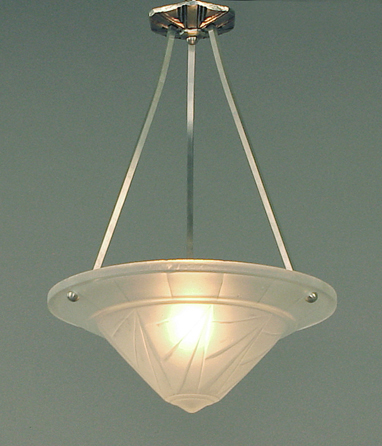
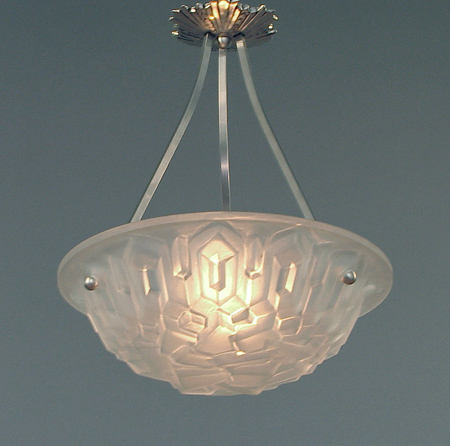
(C) With its delicate geometric designs, this shapely (frosted white glass) bowl exudes a soft, calming tone. It's about 14 inches across and hangs down about 17 inches, configured to your custom length. (e-mail Jack to start the conversation) N.B. The bulb used in the above photo is a "compact fluorescent" and you can see, especially relative to the photos taken below starting with item "J", the huge difference in how the light fills the bowl (and, unfortunately for the purposes of the photography, floods out the details!). On the other hand, in "real life," the compact fluorescent does NOT create this washed-out effect, and provides a very even, white light which you might like better than the light from an incandescent bulb.
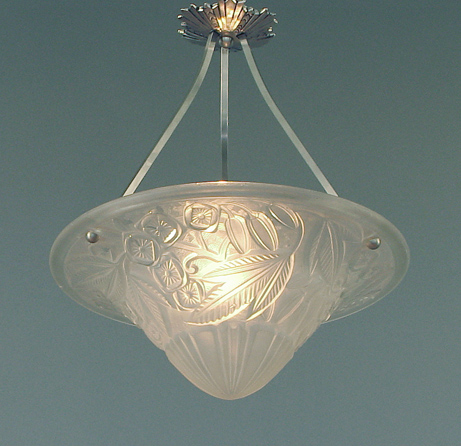
(D) Schneider's designs typically convey the French national passion for Nature. The quality of Schneider's glass was paramount, the delicacy of their work, as evidenced here, sans égal. This bowl measures about 14 inches across and as shown hangs down around 17 inches (re-configured to your custom length). Remember, this Schneider bowl has frosted, non-colored glass! (e-mail Jack to start the conversation)
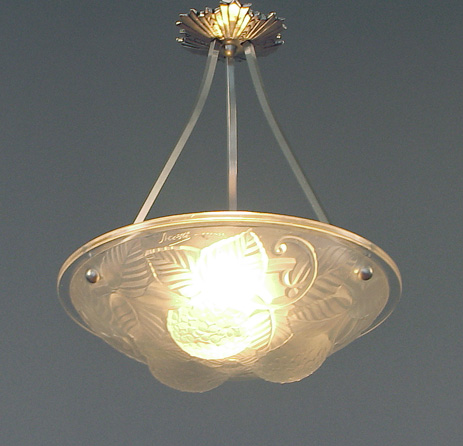
(E) In days of yore, I'd have said "just off the boat," but now, my container-importing thrill sated, it's "just off the plane." This Noverdy bowl seemed totally irresistible, festooned as it is with grapes and leaves (all nine "panels" of them!), nicely signed on the rim, in perfect condition, so on the plane it went. Wow, in solidly "good as it gets" territory! As shown, 14 across and 16 long, but I can make the drop shorter, or longer! (e-mail Jack to start the conversation)
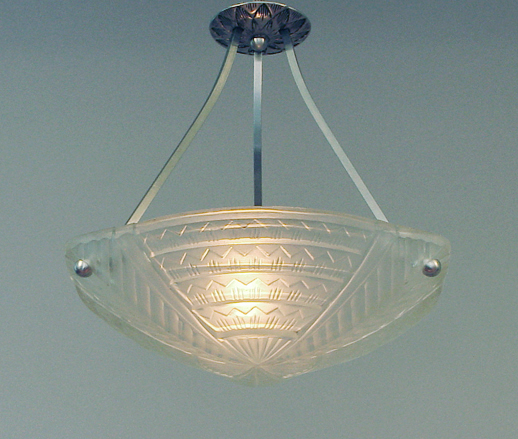
(F) This Noverdy bowl is super-rare and guess why – it’s GORGEOUS!! So who would want to sell theirs? Most French lighting bowls are round, some with better designs than others, but finding 3-sided bowls takes some serious work. Degué made several, with varying results. What’s special about the decoration of this bowl is, of course, its geometric Art Deco patterns. With its stepped pyramidal structure, it’s impossible not to think of the word “ziggurat,” which is used so often to describe the most sophisticated Art Deco designs. This bowl's about 15 inches across (on the diagonal) and as shown hangs down around 17 inches (can be increaseed or decreased). (e-mail Jack to start the conversation
(F1) And whilst we're paddling around in Noverdy waters, let's not forget this new arrival, a most handsome and discreet bowl by that masterful company. It hangs down 22 inches as shown and of course that can be altered; like most French bowls, it's about 14 inches across. (e-mail Jack to start the conversation)
(G) "G" is for hydranGeas, and the blossoms couldn't be more pronounced (and gorgeous) than on this bowl signed Arrers, a maker of extremely high quality glass "back in the day." It measures about 13 1/2 across, and hangs around 16 inches long as shown here. Configured to your custom length.. (e-mail Jack to start the conversation)
(L) This signed Muller, with its multi-faceted, intricate design, typifies the high level of design and manufacturing excellence of that storied Luneville firm. There are a couple of small bubbles in the glass, there since "birth." Notice the unusual configuration of not three, but four tubles descending from the canopy -- one extra for symmetry and extra visual punch. About 14 across, hanging 18 inches long as shown. (e-mail Jack to start the conversation)
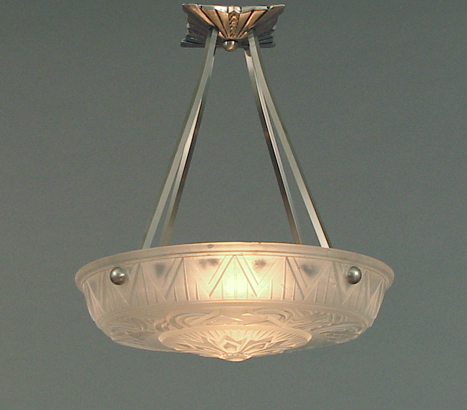
(M) Here's a handsome geometric bowl by Degué which looks like cubes of ice (great for the bar!) It's 13 3/4 inches across and with the apparatus shown, about 17 inches long. Nicely signed Degué in the mold. Configured to your custom length. (e-mail Jack to start the conversation)
(N) This unsigned bowl has the complex, highly detailed geometric designs one associates with Muller glass. A real beauty! It's about 14 inches across and hangs down about 17 inches, as shown. Configured to your custom length. (e-mail Jack to start the conversation)
(Q) Here's another truly stunning (and how seldom I use that overworked term!) bowl by the Grand design Master himself, Pierre d'Avesn, during his tenure at the esteemed Lorrain glass works. This particular design, featuring stylized floral elements, veers close to our "best of the best" Art Deco design territory! It's also extra-wide, at 40 cm (16 inches). Configured for your custom length. (e-mail Jack to start the conversation)
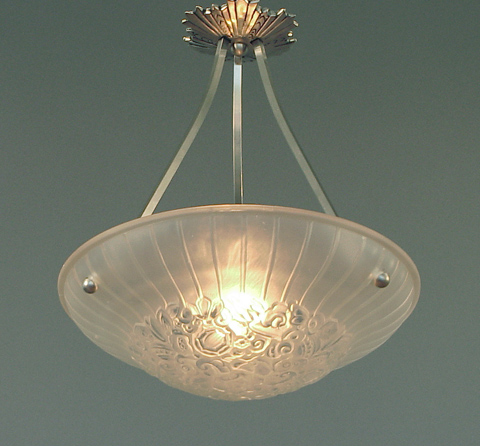
(U) A spare but elegant design...about 14 inches across and hanging down around 17 inches. Configured to your custom length. (e-mail Jack to start the conversation) |
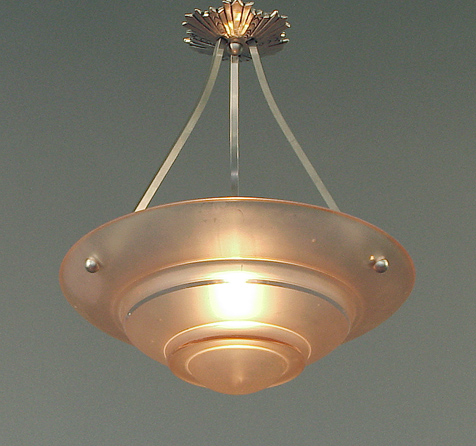
(Z) Some French bowls from the Art Deco period are tinted pink, this being one fine example; and here we have a spare, compelling Modernist design. About 14 inches across, hanging down about 17 inches as shown. Configured to your custom length. (e-mail Jack to start the conversation)
|
|
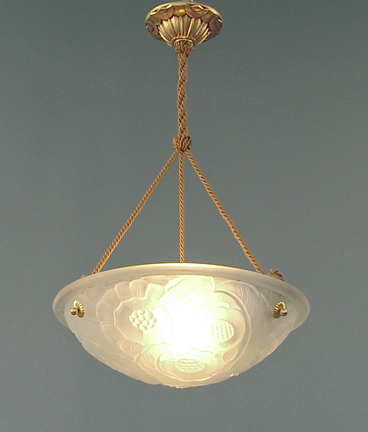
Another hanging option for these frosted bowls is the "cordelier," a silky fabric-woven cord which holds the bowl aloft; the electrical wires run through one of the three cords (zut alors, zos French!). Thusly configured, the bowl will hang at about two feet, but I can reduce that to about 18 inches in a pinch. This bowl is sold, but any of my pressed glass or art glass bowls can hang from this cordelier. The very pleasing antique art deco canopy (pictured above) can replace the "stock" canopy (not pictured, too boring), for $85 additional.
|